
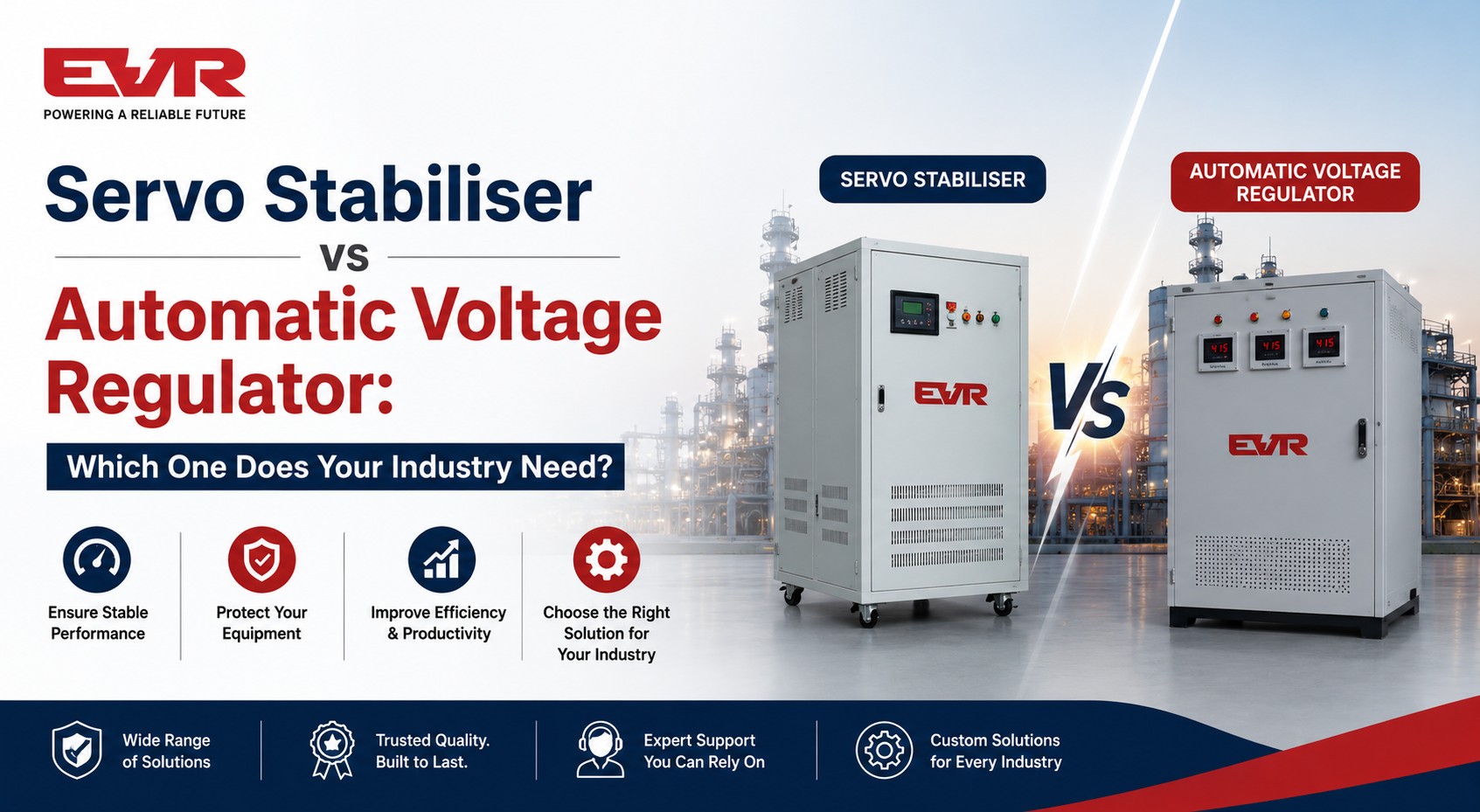
Power quality problems exist in every industrial facility, whether known or not. Whether it’s details like voltage fluctuations on upstream networks during peak loads causing plant trips and unplanned downtime, or brownouts being reported as high-frequency occurrences, sudden surges have been very common, especially in manufacturing corridors with multiple heavy industries sharing the same feeder lines. There can be sudden spikes; these are not edge cases; this is the ground reality across most Indian industrial grids.
There is a key question that challenges your decision between the equipment that lasts and operates optimally, the servo stabiliser vs the automatic voltage regulator, which technology better meets the power quality demands of your operation? In fact, getting this wrong is a very expensive mistake, and the right answer is more nuanced than typical procurement checklists suggest.
The Core Difference: Mechanism
The two devices are both voltage regulators, but they work in completely different ways.
A static electronic circuit combined with an automatic voltage regulator (AVR), usually involving autotransformers with fixed taps and switches at a preset voltage level between the taps. It is quick, efficient, and designed for applications with moderate, stable voltage fluctuations.
In contrast, a servo stabiliser has a motorised variac, which is common to the servo mechanism & control circuit. It has to mechanically turn the variac back and forth to continuously change the output and effectively average out loads in real time over a substantial range of input voltages.
Indeed, the AVR vs servo stabiliser difference is starkest in extreme or unstable grid conditions, where an AVR switches between fixed correction levels, whereas a servo stabiliser provides a genuinely continuous, stepless output that is vital for sensitive or high-draw devices. Incorrect voltage protection selection won’t flag as a malfunction alert. You can see it in the longevity of machines, rejections of product batches, and mounting maintenance invoices.
Servo vs AVR Stabiliser
| Parameter | Servo Stabilizer | Automatic Voltage Regulator (AVR) |
| Correction Method | Stepless (continuous motorised) | Stepped (tap switching) |
| Input Voltage Range | 士50% and Beyond | Typically 土20-25% |
| Response Time | 20–80 ms (motor-dependent) | ≅10-25 ms (Electronic) |
| Output Accuracy | 土1%or better | 土3-5% |
| Best Suited For | Heavy / Sensitive Industry | Light / Commercial Loads |
| Maintenance Needs | Periodic (motor, brushes) | Minimal (no moving parts) |
| Cost Profile | Higher upfront, lower downtime cost | Lower upfront, risk of under-protection |
| Load Capacity | Up to several MVA | Typically under 500 kVA |
When is a Servo Stabiliser a Perfect Choice?
A servo stabiliser is not a luxury solution but a basic need for any plant to protect against the loss of capital equipment, which costs crores to replace.
- Preserving High-Value Capital Assets
A baseline industrial-use servo stabiliser is essential in heavy manufacturing sectors such as steel rolling and textile units. A dedicated power protection system is crucial in these environments, where massive, varying loads create internal disturbances that must be continuously filtered to protect equipment.
- Micro-Deviations in CNC Machining
For precision engineering, even a minor voltage step-change can cause micro-deviations in servo drives. While a standard servo stabiliser vs an automatic voltage regulator comparison might suggest both work, only the stepless output of a servo system prevents tool breakage and dimensional inaccuracies in CNC centres.
- Managing Real-World Grid Fluctuations
While there is a nominal range (e.g., +/-10 %), manufacturers need to consider actual grid swings, not just average ranges. In zeroth order, grid voltages around key manufacturing hubs like Tamil Nadu regularly fluctuate outside the range that a conventional automated voltage regulator can correct, and a heavy-duty servo-controlled solution is required.
- Bridging the Technology Gap
When evaluating internal disturbances versus external grid spikes, understanding the differences between the items themselves to form an opinion on which servo stabiliser or automatic voltage regulator to choose matters a lot. If the facility operates heavy, motorised equipment, a stabiliser of superior engineering guarantees operational health in the long run.
- Dealing with Excessive Load Variations
A good voltage regulator for industrial use must withstand high surge currents. This is where servo stabilisers shine, providing wide-range stabilisation through the inductive action of complicated cycles, which also benefits from the use of ultra-isolation transformers. Incorporating them with servo instability removes high-frequency noise in the line.
Industry-Specific Use Cases for a Servo Stabiliser
- CNC & Precision Engineering: This needs continuous, stepless correction to protect sensitive controller electronics and drive performance.
- Textile & Weaving Mills: Necessary in order to eliminate these thread breaks/pattern defects following sudden voltage sags at high speed.
- Metal and Steel Processing: The high-kVA servo units are the only solution that can directly withstand extreme load swings typical of rolling, pressing, and smelting operations.
- Injection Moulding/Plastics: Wide-range stabilisation is required, as these units combine heavy motors and heating elements.
When do AVRs Do Well, and Where They Fall Short?
It is inaccurate to dismiss automatic voltage regulators as inferior; for the right application, they are an excellent, compact, and maintenance-free choice. Because they lack moving parts, they offer extremely fast electronic response, making them ideal for protecting HVAC control panels and commercial lighting.
- Ideal for Stable, Electronic Loads: The right AVR solution is best suited for environments where voltage deviations are modest and load profiles are stable, such as IT server racks and medical diagnostic instruments.
- The Correction Bandwidth Limit: The critical limitation of an AVR appears in heavy industrial settings where voltage swings exceed its narrow correction range. Unlike a servo stabiliser for industrial use, which adjusts continuously, an AVR switches between fixed taps, which can lead to under-protection during extreme grid instability.
- The Risk of Switching Transients: Because an AVR uses step correction, it can produce a brief electrical transient at every switching event. While this is a non-issue for electronic loads, it can be harmful to sensitive motors, making the regulator choice a matter of equipment longevity.
- Precision vs Speed: While AVRs are fast, they cannot match the output accuracy of a quality servo voltage stabiliser, which is the gold standard for maintaining voltage stability in a manufacturing plant.
- Industrial Scale and Lifespan: For entire plant feeds, only industrial servo stabilisers offer MVA scale capacity. Investing in the best voltage regulator for heavy machinery isn’t just about stability; it extends the average motor lifespan by 50% by eliminating the heat and stress caused by poor regulation.
Choosing the Right Solution for a Manufacturing Plant
The most appropriate voltage regulator for heavy equipment is seldom a single piece of hardware; it is the optimal mix of protection devices specified to the actual load profile. Choosing a voltage stabiliser for an industrial manufacturing plant must be a methodical process that assesses 4 parameters:
- the range of voltages, and its composition,
- The supply you will provide in peak load situations.
- Your connected kVA load, kVA, and
- The maintenance on it.
High uptime requirements in a facility that runs three shifts mean they are willing to accept regular motor brush checks for the servo stabilisers, higher output precision, leading to near-ideal voltage delivery each and every shift.
Similarly, plants with harmonic-heavy environments, particularly those with large VFD-driven motors, welding equipment, or rectifier loads, should consider whether further power conditioning, such as harmonic-mitigating transformers, should accompany their stabiliser selection. Voltage regulation and harmonic mitigation solve different problems; in a demanding manufacturing environment, you often need both working together.
Galvanic isolation between the supply and the load is equally important for facilities operating both precision electronics and heavy machinery. Ultra Isolation transformers are typically placed in parallel with stabilisers to provide greater noise and transient immunity to control systems, PLCs & instrumentation circuits housed within the same panel as high-power loads.
Stop Guessing and Get the Right Protection for Your Plant
Choosing between a servo stabiliser and an automatic voltage regulator is a decision that will impact your factory’s productivity for the next decade. Do not leave your multi-crore machinery at the mercy of an unstable grid. Whether you need a high-kVA servo unit for a massive plant or a fast-acting AVR for sensitive diagnostic tools, our engineering team is ready to help. Reach out to EVR Power today for a comprehensive energy audit and a customised power protection solution tailored to your industry’s specific needs.
FAQs
Servo stabiliser vs AVR, what’s the difference?
A servo stabiliser utilises a motorised variac to provide continuous, stepless voltage correction over a wide input range, while an electric tap-switching AVR is typical for applications with lighter, more stable loads.
Which industries need a servo stabiliser the most?
Servo stabiliser installation is widely used in industries with high, variable, or motor-driven loads, such as textile mills, CNC machining, steel plants, injection moulding, and food processing.
Can a servo stabiliser protect CNC machines?
Yes, a servo stabiliser provides stepless output, eliminating micro-voltage transients that cause CNC servo drive errors, controller resets, and dimensional defects in precision machining.
How does EVR Power’s stabiliser handle extreme voltage swings?
EVR Power’s servo stabilisers are designed to work with extremely substandard input corrections, providing ±1% output even when the grid voltage is well beyond all acceptable norms.
How often should a factory servo stabiliser be serviced?
The general opening up of the servo stabiliser for inspection should be done every six months under general industrial operating conditions, including checking motor brushes and variac contacts for rust to restore good working order.
0 Comments