
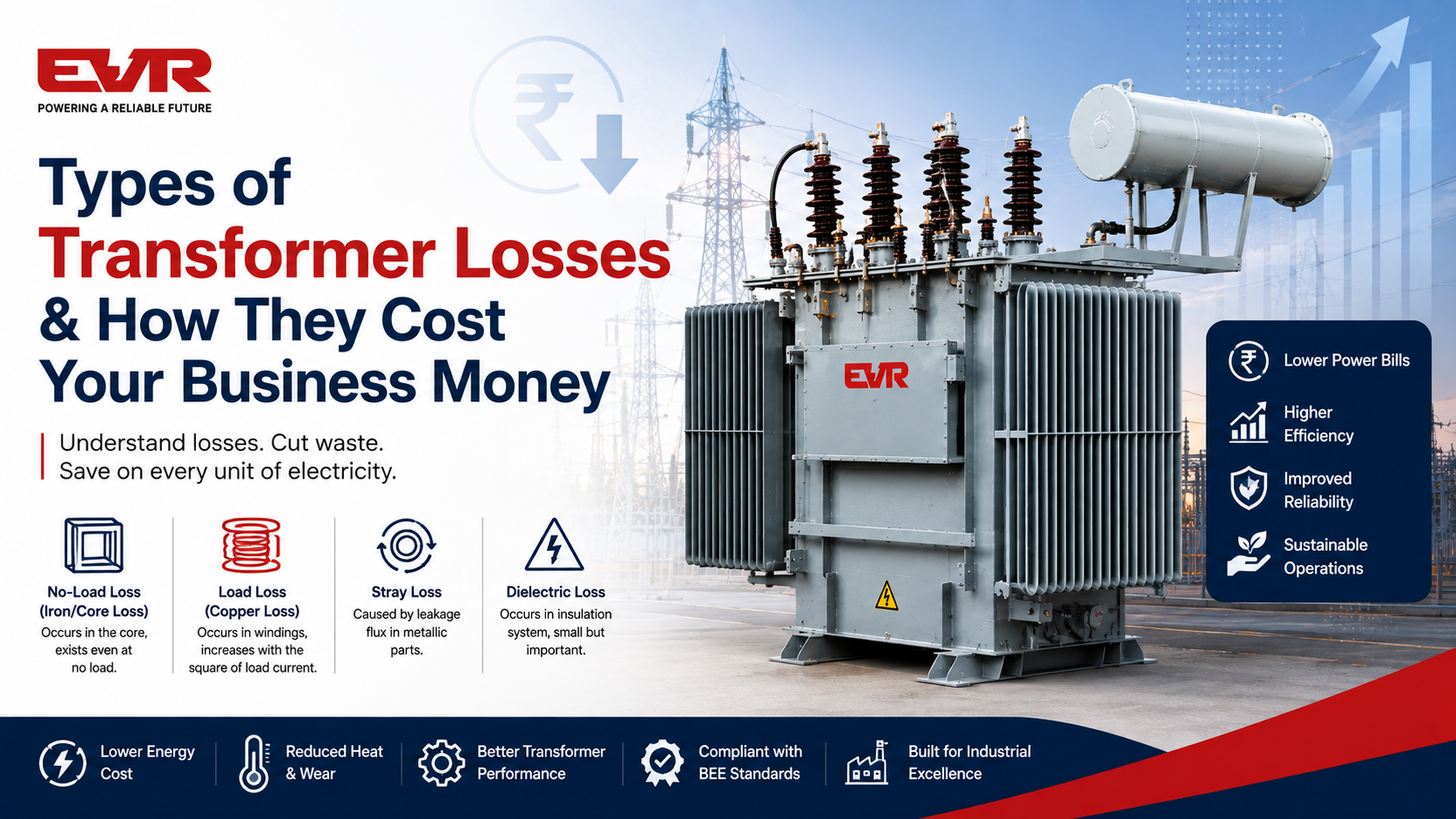
If a factory’s electricity bill keeps climbing even though production hasn’t changed, the transformer could be part of the problem. Every transformer loses some energy as heat during operation, that’s simply how the equipment works. But when those losses drift too high, it’s not just power being lost, it’s money, every hour the unit stays energised.
This guide breaks down the real types of transformer losses, what they cost an industrial plant in India, and what can be done to cut that cost, starting with the next purchase or maintenance cycle.
Types of Transformer Losses
Before inefficiency can be addressed, its source must first be identified. Broadly, losses fall into two categories:
- No-load losses (Iron/Core losses): occur in the core due to hysteresis and eddy currents, and exist continuously, even when the transformer is energised but not supplying load.
- Load losses (Copper losses): occur in the windings due to conductor resistance, and rise as the square of the load current. The higher the current, the greater the loss.
Smaller contributors, stray losses (leakage flux striking metallic parts) and dielectric losses (in the insulation system), typically make up a small share of total losses but matter more in larger, high-voltage units.
Causes of Transformer Power Loss in Indian Industries
Common causes in real-world Indian factory conditions:
- Ageing or low-grade core steel with high hysteresis loss
- Undersized or degraded winding conductors increasing resistance
- Poor load management, with transformers running well below or above optimal loading
- Voltage fluctuations and harmonic-rich loads (common with VFDs, welding equipment, furnaces)
- Overdue maintenance: loose connections, degraded oil, and poor cooling quietly push losses upward
The Real Business Impact on Power Bills
Maintenance teams often underestimate one thing: transformer losses are not a one-time inefficiency, they are a recurring monthly cost for as long as the unit remains in service.
A transformer with elevated no-load and load losses draws extra kWh from the grid around the clock, regardless of production. That extra consumption appears directly on the utility bill, and on a demand-based industrial tariff, it can also push up peak demand charges. Multiplied across months and years, an “inefficient but working” transformer can end up costing more in wasted electricity than the price difference of buying a properly rated, low-loss unit in the first place.
Impact of 1% Efficiency Loss on Monthly kWh Cost
An illustrative estimate of what 1% additional loss costs per month across common transformer sizes. Assumed conditions: 70% average loading, 0.9 power factor, continuous 24/7 operation, tariff of 8 rupees per unit. Actual numbers vary with load profile and tariff structure.
| Transformer Rating | Avg. Load (kW) | Extra kWh Lost/Month (1%) | Approx. Extra Cost/Month |
| 500 kVA | 315 kW | ~2,270 kWh | ~Rs. 18,100 |
| 1000 kVA | 630 kW | ~4,540 kWh | ~Rs. 36,300 |
| 2000 kVA | 1,260 kW | ~9,070 kWh | ~Rs. 72,600 |
| 5000 kVA | 3,150 kW | ~22,680 kWh | ~Rs. 1,81,400 |
Even a small 1% efficiency gap on a mid-sized transformer can quietly cost a plant tens of thousands of rupees a month, compounding every billing cycle it stays inefficient.
Core Loss vs Copper Loss: Which Costs More?
A common question when evaluating transformer specs: which loss type should take priority?
Core loss (no-load loss) is constant, running around the clock regardless of load. For transformers operating continuously at partial or variable load, a common setup in Indian factories, core loss often accounts for the larger share of annual energy cost. Copper loss (load loss) scales with the square of the current, mattering most for transformers running near or above rated capacity, such as heavy-duty continuous process loads.
The takeaway: if a transformer is lightly to moderately loaded most of the time, focus on core loss. If it runs close to full capacity around the clock, copper loss becomes the bigger factor. See our comparison of iron loss vs copper loss for a deeper technical breakdown.
2024-25 BEE Energy Efficiency Standards
The Bureau of Energy Efficiency (BEE) continues tightening star-rating and minimum efficiency benchmarks for distribution and power transformers as part of India’s industrial energy efficiency push. For 2024-25 purchases or replacements, this generally means higher minimum efficiency thresholds to qualify for star ratings, stricter no-load loss limits on new distribution transformer designs, and a continued push toward amorphous-core and low-loss silicon steel construction for higher-star-rated units. Exact slabs and limits are periodically revised, so verify current notifications with BEE or the transformer manufacturer before finalising a purchase.
How to Choose a Low-Loss Transformer
Key decisions affecting lifetime running cost:
- Match the rating to actual load profile, not merely peak demand. Both oversized and undersized units operate less efficiently.
- Review no-load and load loss figures on the datasheet, rather than relying solely on efficiency percentage at rated load.
- Consider amorphous-core construction for long duty cycles, where no-load losses accumulate most.
- Confirm BEE star rating and compliance with the latest notified standards.
- Account for total cost of ownership, purchase price plus 15-20 years of energy losses, not upfront price alone.
For plants ready to upgrade, EVR Power’s range of energy-efficient power transformer and low-loss distribution transformer solutions are built to meet current BEE benchmarks while matching real Indian industrial load conditions.
5 Ways to Reduce Transformer Losses
A full replacement isn’t always necessary. Ways to improve efficiency in existing operations:
- Right-size load distribution. Avoid running one transformer near overload while another sits idle; balance load across units.
- Improve power factor with capacitor banks. Poor power factor increases current draw and copper losses for the same real power delivered.
- Keep cooling systems clean and functional. Oil degradation and blocked radiators raise winding temperature, increasing resistive losses.
- Tighten and inspect connections regularly. Loose terminations create localised heating and added resistance losses.
- Schedule periodic efficiency audits. Many plants only discover excess losses once a proper load and thermal audit is done.
EVR Power’s transformer efficiency audit and repair service can identify exactly where losses are occurring and what it would take to fix them.
Stop Paying for Losses You Can Measure
Transformer losses aren’t a one-time cost, they’re a quiet, recurring drain that keeps showing up on the power bill for as long as the unit stays in service. Left unaddressed, even a small efficiency gap compounds into a significant expense over years of continuous operation. The good news is that both the diagnosis and the fix are well understood: know where the losses are coming from, whether it’s core, copper, or poor load management, and act on it, whether that’s a maintenance fix or a properly rated replacement.
For plants unsure where they currently stand, EVR Power’s transformer efficiency audit and repair service identifies exactly where a unit is losing money and recommends the most cost-effective way to fix it. For those ready to upgrade, EVR Power’s range of energy-efficient power transformer and low-loss distribution transformer solutions are built to match real Indian industrial load conditions. Get in touch to assess your setup before the next billing cycle.
FAQs
What are the main types of losses in an industrial transformer?
The two primary types are no-load (core/iron) losses, occurring continuously due to core magnetisation, and load (copper) losses, occurring in the windings and increasing with current drawn. Smaller stray and dielectric losses also contribute, particularly in larger units.
How does transformer inefficiency increase electricity bills?
An inefficient transformer draws extra kWh from the grid to compensate for internal losses, even when production load hasn’t changed. That extra consumption directly adds to monthly energy cost and, under demand-based tariffs, can also raise peak demand charges.
What is the difference between core loss and copper loss?
Core loss (no-load loss) happens continuously in the core regardless of load, while copper loss (load loss) happens in the windings and increases with the square of the current. Which one dominates total cost depends on typical loading.
How can I tell if a transformer is running efficiently?
The clearest indicators are datasheet loss figures compared against actual metered consumption, abnormal operating temperatures, and a load/thermal efficiency audit. A rising bill with unchanged production is often the first practical warning sign.
Can EVR Power assess an existing transformer for energy efficiency?
Yes. EVR Power offers a dedicated transformer efficiency audit and repair service to assess actual loss levels, identify the root cause of excess energy consumption, and recommend whether repair, retrofitting, or replacement with a low-loss unit makes the most financial sense.
0 Comments