
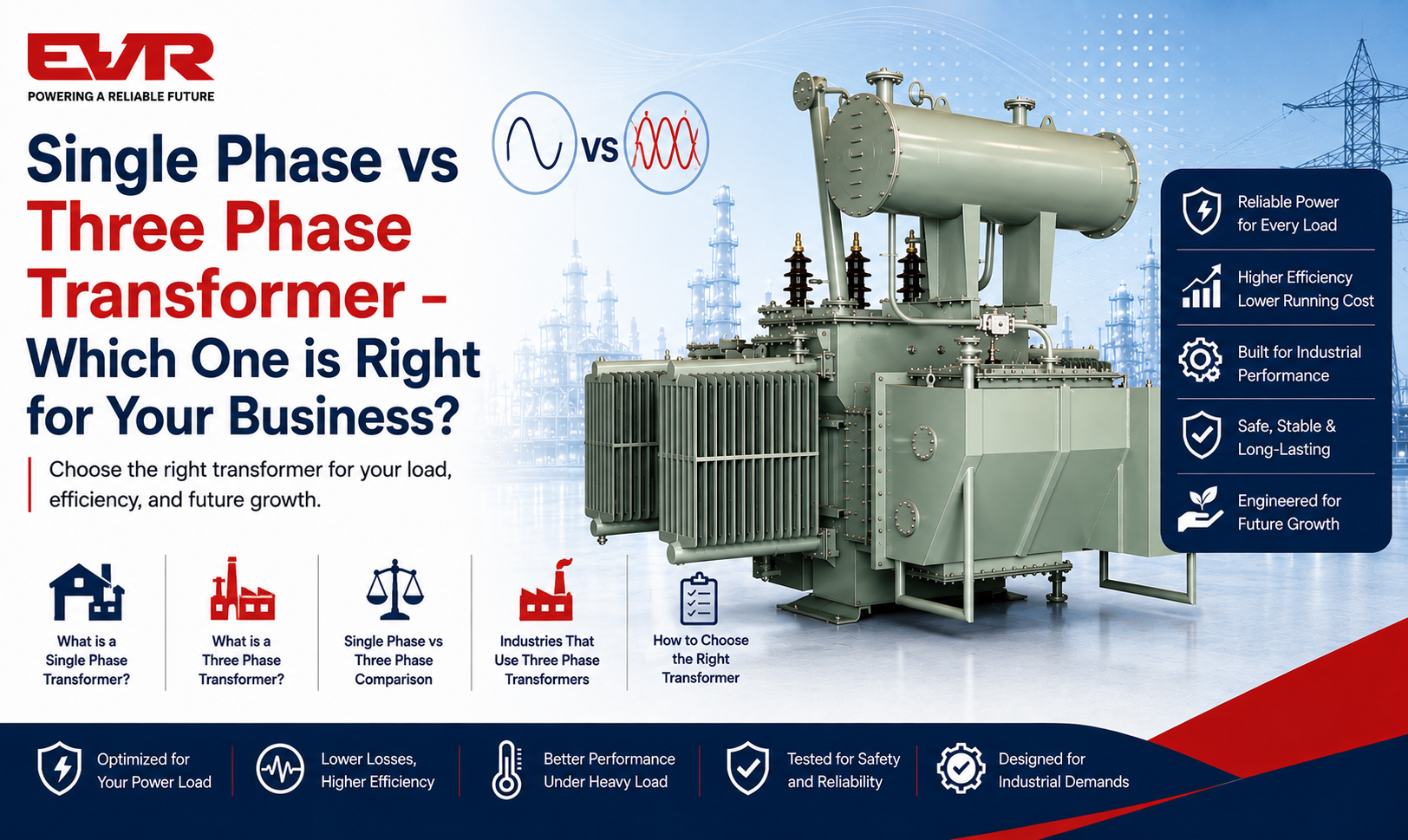
Setting up a factory or expanding production capacity raises one question early on: single phase or three phase transformer. The answer determines equipment compatibility, running cost, and whether the electrical setup can support future expansion.
This guide breaks down single phase vs three phase transformer for industry use in a few minutes, covering how each works, where each fits, and how to decide. Whether the facility is a small workshop running light equipment or a full production plant with heavy, continuous machinery, the right choice affects both immediate running costs and how easily the setup scales later.
What is a Single Phase Transformer and When is It Used?
A single phase transformer operates on a single alternating current waveform, delivering power through two wires, live and neutral. It is the standard supply type for residential connections and is also common in light commercial and small industrial settings where power demand stays within a moderate range.
A single phase transformer for small industries India typically suits workshops, small-scale manufacturing units, and light machinery that does not require continuous heavy-duty operation. Equipment such as basic pumps, lighting circuits, and smaller motors run efficiently on a single phase distribution transformer without the added infrastructure a three phase connection requires. Many of these smaller setups also rely on step down transformer units to bring supply voltage to equipment-safe levels.
What is a Three Phase Transformer and When is It Used?
A three phase transformer delivers power through three alternating waveforms offset from each other, providing a more consistent and efficient power flow than single phase supply. Knowing when to use three phase transformer in factory settings comes down to load type: continuous, high-demand equipment is where three phase consistently outperforms single phase.
A three phase power transformer is built to handle the sustained current draw of large motors, compressors, and production-line equipment without the power fluctuations single phase supply can introduce under heavy load. This makes it the standard fit as a three phase transformer for heavy machinery across most industrial settings. Depending on the facility’s incoming supply, a step up transformer may also be needed to raise voltage to the level three phase equipment requires.
Single Phase vs Three Phase Transformer: When to Choose Each
The difference between single phase and three phase power supply comes down to a few practical factors, summarised below.
| Factor | Single Phase Transformer | Three Phase Transformer |
| Typical load | Light to moderate (up to a few kW) | Heavy, continuous industrial load |
| Common setting | Small workshops, light commercial units | Factories, production plants, heavy machinery |
| Power efficiency | Lower at high loads | Higher, with reduced conductor loss |
| Equipment supported | Small motors, pumps, lighting | Large motors, compressors, industrial drives |
| Infrastructure cost | Lower upfront cost | Higher upfront cost, better long-term efficiency |
| Scalability | Limited for future expansion | Suited to growing industrial demand |
Industries That Use Three Phase Transformers
Three phase transformers are standard across sectors where equipment runs continuously under heavy load:
- Manufacturing and heavy engineering, where production-line motors and compressors require stable, high-capacity power.
- Textile and processing plants, where machinery operates in long, uninterrupted cycles.
- Automotive and metal fabrication units, where welding equipment and heavy tooling draw significant current.
- Chemical and process industries, where continuous operation and load stability directly affect output quality.
- Large commercial and infrastructure projects, including facilities with sizeable HVAC and pumping systems.
How to Choose the Right Transformer for Your Power Load
Selecting between single phase and three phase power supply comes down to a few practical factors:
- Total connected load. Facilities running light equipment intermittently are generally well served by single phase supply; those running heavy or continuous machinery need three phase capacity.
- Equipment specifications. Many industrial motors and drives are manufactured specifically for three phase input and will not run efficiently, or at all, on single phase power.
- Future expansion plans. A facility expecting to scale production benefits from three phase infrastructure from the outset, since retrofitting later adds cost and downtime.
- Power stability requirements. Processes sensitive to voltage fluctuation perform more reliably on three phase supply.
- Voltage matching. Whether a step up transformer or step down transformer is needed alongside the main unit depends on how the incoming supply voltage compares to what the equipment requires.
- Budget versus long-term efficiency. Single phase setups cost less initially, but three phase systems typically deliver lower running costs per unit of power at industrial scale, a factor closely tied to transformer losses and efficiency over the equipment’s operating life.
Making the Right Call for the Business
A small unit running light equipment has little reason to invest in three phase infrastructure. A facility running continuous, heavy machinery, or planning to scale in that direction, is generally better served by three phase capacity from the start rather than retrofitting later, since upgrading infrastructure after installation adds both cost and downtime. For most businesses, the single phase vs three phase transformer for industry decision comes down to matching the transformer to actual load requirements, both current and future.
Get a quote for single or three phase transformer suited to a specific facility’s power requirements.
FAQs
What is the main difference between a single phase and three phase transformer?
A single phase transformer delivers power through a single alternating waveform, suited to lighter loads. A three phase transformer delivers power through three offset waveforms, providing more consistent and efficient power for heavy, continuous industrial loads.
Which transformer is better for a small manufacturing unit?
A single phase transformer is generally sufficient for a small manufacturing unit running light to moderate equipment. Units planning to scale up or run heavier machinery are better served by three phase capacity.
Can I convert my single phase supply to three phase using a transformer?
Certain phase converter systems can adapt single phase input for specific three phase equipment, but this differs from a standard transformer upgrade and typically comes with efficiency trade-offs. For sustained industrial use, a direct three phase connection is the more reliable long-term option.
What industries typically use three phase transformers?
Manufacturing, textiles, automotive and metal fabrication, chemical processing, and large commercial or infrastructure facilities typically rely on three phase transformers to support continuous, high-load equipment.
Does EVR Power supply both single phase and three phase transformers for industries?
Yes. EVR Power manufactures both single phase and three phase transformers, built to match the specific load and operating conditions of different industrial facilities.
0 Comments