
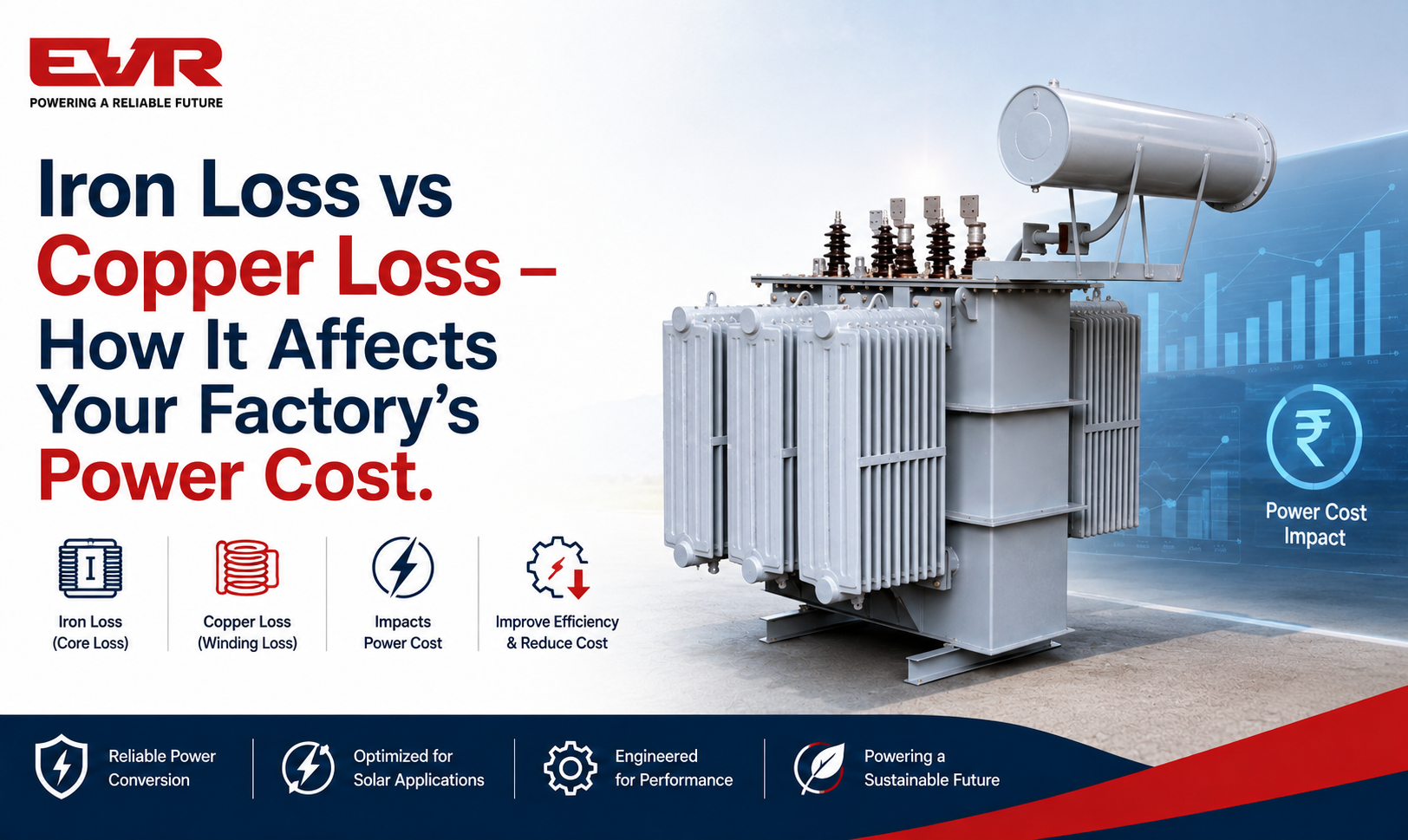
If your plant runs transformers around the clock, iron loss and copper loss aren’t just textbook terms, they’re a line item on your electricity bill. Copper loss and iron loss in transformer units are the two main sources of wasted energy, and depending on your load pattern, one or both could be quietly costing you more than you think every month.
This guide skips the heavy formulas and explains what actually drives these losses, how copper loss specifically hits your power costs, and what to look for when choosing a low-loss transformer for industrial use.
Why Should a Plant Manager Care About Transformer Losses?
A transformer that runs at 97% efficiency sounds fine on paper, but that missing 3% doesn’t disappear, it becomes heat, and heat means wasted electricity you’re paying for around the clock. For a factory running transformers continuously, that adds up fast: higher utility bills, more strain on cooling systems, and a shorter working life for the unit itself.
Iron loss causes in industrial transformers are often overlooked because they’re constant, present whether the transformer is fully loaded or barely used. Copper loss, on the other hand, scales with your load, so a plant running near full capacity for long shifts feels copper loss the most. Knowing which one is driving your costs is the first step to actually reducing transformer losses in your factory.
Iron Loss and Copper Loss: What’s the Difference?
Both losses happen inside the transformer, but for different reasons and in different places.
Iron loss (also called core loss) happens inside the transformer’s core, caused by two effects: hysteresis, where the core material resists being repeatedly magnetised and demagnetised as AC current cycles, and eddy currents, small circulating currents induced in the core by the changing magnetic field. Both convert energy into heat inside the core, regardless of how much load the transformer is carrying.
Copper loss (also called winding loss) happens in the windings themselves, caused by ordinary electrical resistance in the copper or aluminium conductors. The more current flowing through the windings, the more heat gets generated, which is why copper loss rises and falls directly with your plant’s load.
How Copper Loss Increases Your Electricity Bill
| Iron Loss | Copper Loss | |
| Where it happens | Transformer core | Transformer windings |
| Depends on load? | No, stays roughly constant | Yes, increases with load |
| Main cause | Hysteresis and eddy currents | Resistance in the conductors |
| When it matters most | Transformers left on standby or lightly loaded | Transformers running near full capacity for long periods |
Because copper loss rises with the square of the load current, small increases in load can produce a noticeably bigger jump in losses than you’d expect. Here’s a simplified example to show the pattern, not a quote for any specific unit: a transformer with 2 kW of copper loss at 100% load will show roughly 0.5 kW of copper loss at 50% load, since the relationship follows current squared, not current directly. Run that 2 kW loss continuously for a month (720 hours) and you’re looking at roughly 1,440 kWh consumed purely as winding heat, before it powers a single machine on your floor.
At typical industrial tariffs, that’s real money spent heating copper instead of running equipment, month after month. This is exactly why copper loss affects transformer efficiency matters more to a plant manager than an engineer’s spec sheet; it’s a recurring operating cost, not a one-time design detail.
Oil-Type vs Dry-Type Transformer Losses
The type of transformer you choose also shapes your loss profile, not just its age or condition.
| Oil-Type Transformers | Dry-Type Transformers | |
| Typical no-load (iron) loss | Generally lower, due to efficient oil cooling and core design | Generally higher for a comparable rating |
| Load handling | Well suited to high, continuous industrial loads | Better suited to indoor or fire-sensitive locations |
| Maintenance | Requires oil testing and monitoring | Lower maintenance, no oil to manage |
| Best fit | Large industrial and utility loads where efficiency matters most | Indoor plants, hospitals, and sites where fire safety rules out oil-filled units |
Neither type is universally “better”, the right choice depends on your load profile, site constraints, and safety requirements. For most continuous industrial loads, oil-type units tend to offer a lower total loss profile, but a proper efficiency assessment for your specific site is the only way to know for certain.
How to Reduce Transformer Losses in Factory Settings
You don’t always need to replace an existing transformer to bring losses down. A few practical steps for reducing transformer losses in factory operations:
- Right-size the transformer to your actual load. An oversized transformer running mostly idle wastes iron loss on capacity you’re not using.
- Keep load balanced across phases. Uneven loading increases resistive heating in specific windings.
- Schedule regular oil and insulation testing on oil-type units, since degraded insulation increases losses over time.
- Address harmonic distortion, since harmonic currents from variable-frequency drives and other equipment can increase copper losses beyond what the base load would suggest.
- Upgrade core material where replacement is due, since modern silicon steel and amorphous cores cut iron loss by a wide margin compared to older core designs.
How to Choose a Low-Loss Transformer for Your Industry
When you are buying new or replacing an existing unit, a few questions matter more than the spec sheet headline numbers:
- What’s your actual load profile, continuous high load, or intermittent use? This determines whether iron loss or copper loss should weigh more heavily in your decision.
- Does the site require oil-type or dry-type on safety or space grounds?
- What core material and winding design does the manufacturer use, and can they show loss figures at your specific load, not just at rated capacity?
- Can the manufacturer run a transformer efficiency calculation for plant managers to evaluate against your plant’s actual operating conditions, rather than a generic catalogue figure?
EVR Power’s low-loss power transformer range is engineered around exactly this: advanced core materials to reduce iron loss, and winding designs, load matching, and cooling systems built to keep copper loss down under real industrial conditions. For a deeper technical breakdown of every loss category, our guide to types of transformer losses covers stray and dielectric losses as well.
If your existing transformer is older or you’re unsure how much you’re losing to inefficiency, an on-site transformer repair and efficiency check can quantify it before you commit to a replacement.
Frequently Asked Questions
What is the difference between copper loss and iron loss in a transformer?
Iron loss happens in the core and stays roughly constant regardless of load, caused by hysteresis and eddy currents. Copper loss happens in the windings and rises with load, caused by resistance in the conductors.
Which transformer loss is responsible for increasing my electricity bill?
Both contribute, but copper loss usually has the bigger effect on a plant running high, continuous loads, since it increases sharply as load current rises. Iron loss adds a steady baseline cost even when the transformer is lightly loaded.
How do transformer losses affect my factory’s power system efficiency?
Both losses convert electrical energy into heat instead of usable power, which lowers overall efficiency, increases cooling demand, and shortens the transformer’s working life if left unaddressed.
Can I reduce transformer losses without replacing my existing unit?
Yes, in many cases. Balancing load across phases, addressing harmonic distortion, right-sizing usage, and keeping up with oil and insulation testing can all reduce losses without a full replacement.
Does EVR Power manufacture low-loss transformers for industrial plants?
Yes. EVR Power designs transformers with advanced core materials to reduce iron loss and enhanced winding, cooling, and load-matching design to reduce copper loss, built specifically for industrial-scale operation.
Not sure how much your current transformer is costing you in losses? Get a quote for an energy-efficient transformer from EVR Power’s team.
0 Comments